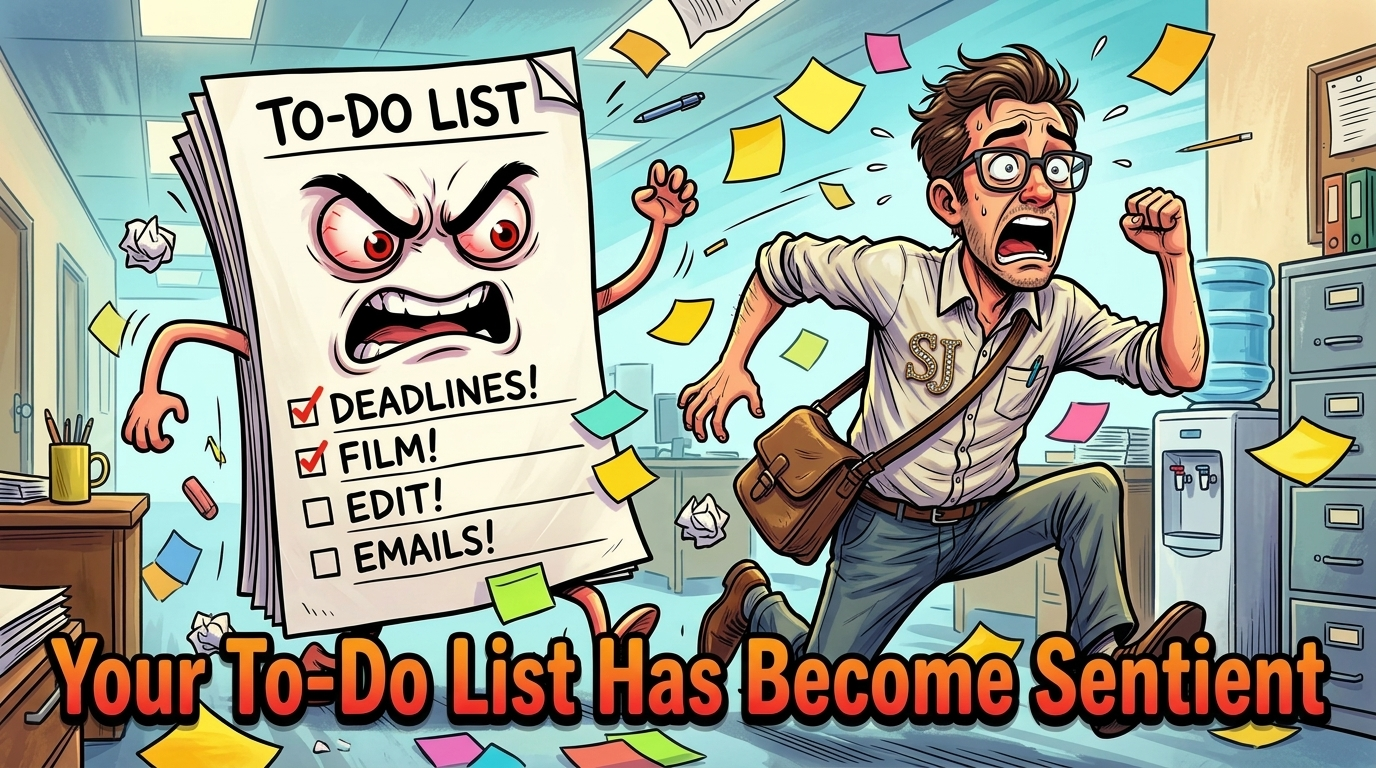
At some point, your business stops giving you things to do and starts giving you orders.
There was a time when your to-do list was helpful.
You wrote down a few things.
You checked them off.
You felt productive.
Then you started building a business.
Now your to-do list has apparently developed opinions.
It wants you to post on social media.
It wants you to write an email.
It wants a blog post.
It wants a video.
It wants a freebie.
It wants a sales page.
It wants you to learn SEO.
It wants you to check your analytics.
It wants you to update something you created six months ago.
It has become less of a list and more of a supervisor.
And apparently, it doesn't believe in lunch breaks.
The Internet Has a Lot of “Shoulds”
One of the fastest ways to make your business feel overwhelming is to start collecting everything other people say you should be doing.
You should be on this platform.
You should be posting every day.
You should have a newsletter.
You should make videos.
You should create a podcast.
You should build an audience.
You should create a freebie.
You should have a funnel.
You should repurpose everything.
You should probably be doing something with short-form video.
And while you're at it, you should learn seventeen new things before Thursday.
None of these ideas are automatically bad.
That's what makes this tricky.
Many of them can be useful.
But useful doesn't mean necessary.
Your Business Doesn't Need Every Available Strategy
There is a strange assumption that a serious business must eventually use every available marketing method.
It doesn't.
You don't need to be everywhere.
You don't need to create every type of content.
You don't need to join every platform.
You don't need to master every strategy you've ever heard about.
You need to find the things that actually make sense for your business and your audience.
That's a much smaller job.
And considerably less exhausting.
Your To-Do List Needs a Bouncer
Here's a simple way to look at your task list:
Not everything gets in.
Before adding another task, ask:
Does this help me build, sell, serve, or grow?
If the answer is yes, it may deserve a place on the list.
If the answer is “Well, everybody else seems to be doing it...”
That's not necessarily a good enough reason.
And if the answer is:
“I'm not really sure, but I feel like I should...”
Congratulations.
You've just caught your to-do list trying to sneak something past the bouncer.
Choose Your Few Things
Instead of trying to do everything, choose a small number of activities you can actually maintain.
Maybe you enjoy writing.
Great.
Your blog and email list might become important parts of your business.
Maybe you love video.
Fantastic.
Video may be a natural way for you to connect with people.
Maybe social media makes you want to hide behind a medieval castle wall.
That's useful information too.
You don't have to force yourself to build your entire business around something you hate just because someone on the internet said it's essential.
Find the places where your strengths and your audience's needs overlap.
Then put your energy there.
More Activity Isn't Always More Growth
This is another trap.
When something isn't growing as quickly as you'd like, the instinct can be:
Do more.
More posts.
More emails.
More platforms.
More content.
More offers.
More everything.
But sometimes the answer isn't more.
Sometimes the answer is better focus.
You might discover that one useful article consistently brings people to your business.
Or that your email list responds to a particular kind of content.
Or that one product gets more attention than everything else you've created.
Those are clues.
Pay attention to them.
You don't need to create twelve new things just because one thing isn't moving fast enough.
Give Yourself Permission to Ignore Things
This might be one of the most useful skills you can develop as a business owner:
The ability to say, “That's not for me right now.”
Not:
“That's a terrible strategy.”
Not:
“Nobody needs that.”
Just:
“That's not where I'm putting my energy.”
You can always reconsider later.
Put interesting ideas on your Later List.
Let your future self investigate them.
Your present self has enough to do.
Your To-Do List Works for You
A to-do list is supposed to help you decide what needs your attention.
It isn't supposed to determine the entire direction of your business.
So take a look at yours.
If it contains thirty-seven things that are all supposedly urgent, something has gone wrong.
If every new strategy immediately becomes a new obligation, something has gone wrong.
If you're spending more time maintaining your marketing activities than building the business those activities are supposed to support, something has definitely gone wrong.
Your list needs boundaries.
You are in charge.
Not the list.
Not the algorithm.
Not the latest business trend.
And definitely not the angry piece of paper currently chasing you around the office.
You Don't Need to Do Everything
Your business can grow without you doing everything.
You can choose.
You can simplify.
You can experiment.
You can stop doing things that aren't helping.
You can leave some strategies for later.
You can build an audience without becoming a full-time content production department.
The goal isn't to have the longest to-do list in the kingdom.
The goal is to build a business that moves forward.
So go ahead.
Cross a few things off.
Move a few things to the Later List.
Ignore a few things entirely.
And if your to-do list starts growing arms and legs and chasing you down the hallway...
Well, that's probably Stickly's fault.
You didn't hear that from me.
Comments