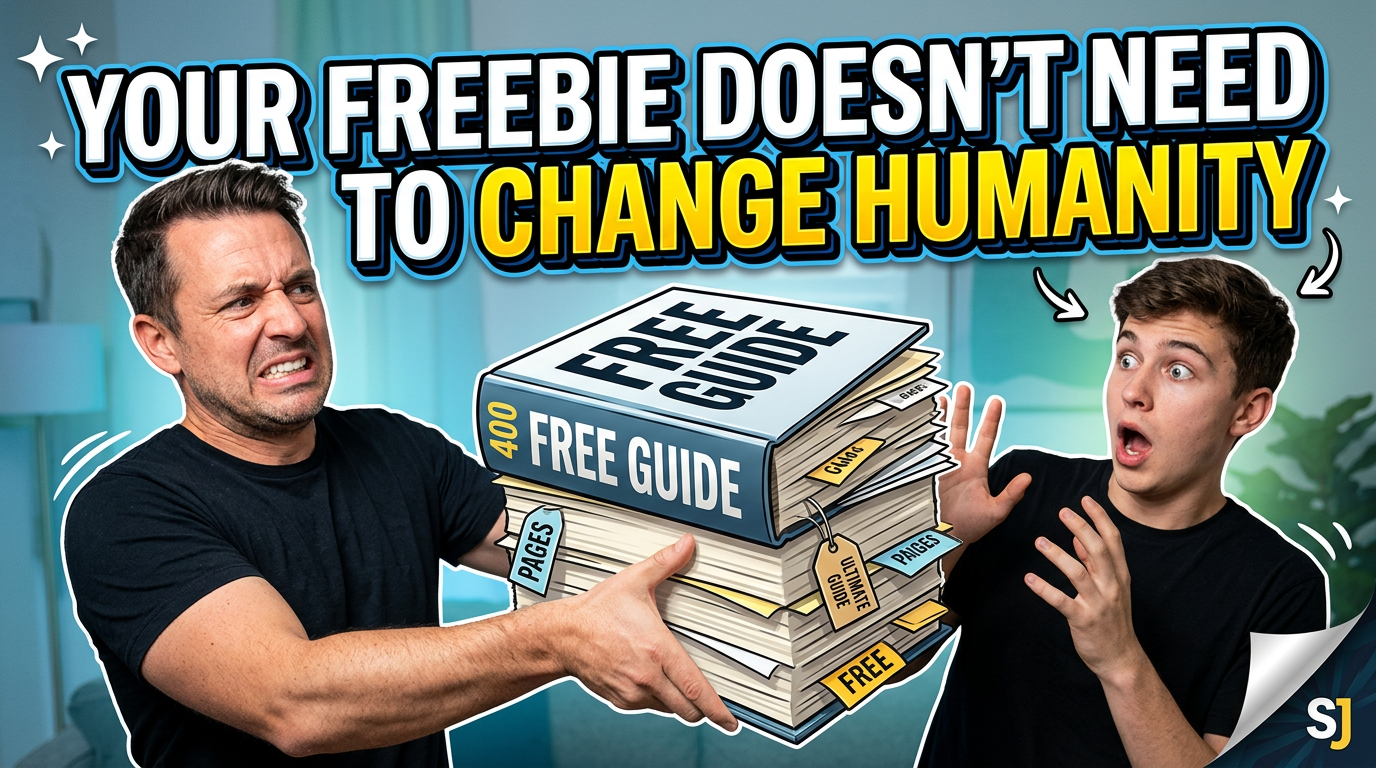
You decided to create a freebie.
Something useful people could download in exchange for joining your email list.
Simple enough.
Maybe a checklist.
A short guide.
A helpful worksheet.
Then you started thinking.
Perhaps it should include examples.
And a few templates.
Maybe a resource list.
A bonus chapter wouldn't hurt.
Before long, your simple little freebie has become a 47-page masterpiece with a table of contents, an appendix, and enough supporting material to qualify as required reading at a small university.
Congratulations.
You've created a free product that may require its own free product to explain how to use it.
Sound familiar?
The Freebie That Became a Full-Time Project
Creating something valuable for your audience is a good idea.
A useful free resource can help people solve a small problem, learn something new, or take their first step toward a bigger goal.
But somewhere along the way, creators sometimes confuse useful with comprehensive.
They start believing their freebie needs to include everything they know about a subject.
Every tip.
Every detail.
Every possible question someone might ask.
And every bonus they can think of.
That's how a simple checklist becomes a workbook.
The workbook becomes a guide.
The guide becomes a course outline.
And suddenly, the freebie has consumed three weeks of your life.
A freebie doesn't have to teach someone everything. It needs to help them do something useful.
That's a much smaller assignment.
Give Your Freebie One Job
Before creating another page, decide what you want your freebie to accomplish.
Does it help someone:
- Make a decision?
- Complete a small task?
- Solve one specific problem?
- Understand a confusing topic?
- Get organized?
- Take the first step toward a larger goal?
Choose one primary purpose.
For example, imagine you want to attract people interested in starting a digital product business.
You could create a massive guide covering product creation, websites, pricing, marketing, email lists, and sales funnels.
Or you could create a simple worksheet that helps someone identify one product idea they could develop.
Both might be useful.
But the worksheet has a much clearer job.
It helps someone move from I have no idea what to create to I have a product idea worth exploring.
That's a meaningful result.
And it doesn't require 100 pages.
Small Doesn't Mean Unimportant
There's a tendency to believe that a free resource must look impressive to be valuable.
A thick ebook seems more substantial than a one-page checklist.
A collection of 25 templates looks more generous than three carefully selected ones.
A 10-part training series appears more impressive than a short tutorial.
But size doesn't determine usefulness.
Think about the last time you downloaded something.
Did you necessarily want a giant resource?
Or did you want the answer to a question, a solution to a problem, or a shortcut that saved you time?
People often appreciate resources that are easy to understand and simple to use.
A well-designed checklist can be more helpful than a 60-page guide if the checklist is what they actually need.
Don't make people work harder just to prove how much effort you put into creating the freebie.
Match the Freebie to the Audience
A good freebie should attract people who are interested in the subject you want to be known for.
This is important.
If your business is about helping people create digital products, a free resource about organizing product ideas makes sense.
If you help people grow an audience, a content planning worksheet might be a better fit.
If you teach website building, a website launch checklist could be useful.
The connection should be natural.
Someone should be able to download your freebie, find it helpful, and understand why they might want to hear more from you.
That doesn't mean your freebie needs to sell something immediately.
It simply means the resource should fit the larger conversation you're having with your audience.
A random giveaway might attract downloads.
A relevant freebie can attract people who are genuinely interested in what you offer.
Those are two different things.
Try the One-Problem, One-Resource Approach
If you're struggling to decide what to create, try this simple method.
Step 1: Identify one problem.
What is something your audience struggles with?
Be specific.
Instead of choosing starting a business, consider choosing a first product idea.
Step 2: Choose one useful solution.
What could help someone make progress?
A checklist, worksheet, short guide, template, or resource list might be enough.
Step 3: Keep the instructions simple.
Explain what the resource does and how to use it.
Don't bury the useful part under several pages of explanation.
Step 4: Give it a clear finish line.
What should someone be able to do after using it?
If they can accomplish that task, your freebie has done its job.
Step 5: Stop adding things.
This might be the hardest step.
Once the resource delivers the promised result, resist the urge to turn it into something bigger.
You can always create another resource later.
You don't have to put your entire knowledge library into one download.
Let Your Freebie Lead Somewhere
A free resource can be the beginning of a relationship.
Someone downloads your checklist.
They receive a welcome email.
You share another useful tip.
They discover one of your articles.
Over time, they learn more about what you do and how you can help.
That's the real opportunity.
Your freebie doesn't need to make a sale, solve every problem, or turn a stranger into a lifelong customer in one afternoon.
It simply needs to provide a good first experience.
Think of it as opening the door, not building the entire house.
And if the person enjoys what they find inside, they may want to explore what's next.
Put Down the 400-Page Free Guide
If you're creating a freebie right now, take a step back.
Ask yourself:
- What is the one problem this resource solves?
- Does it need all these extra pages?
- Can someone use it without reading a small encyclopedia first?
- Am I adding value, or am I adding volume?
- Could I make this simpler without making it less useful?
Remember, your audience doesn't need a demonstration of everything you know.
They need something that helps them.
A useful worksheet.
A clear checklist.
A short guide.
One good idea they can put into action.
That's enough.
You can save the bigger projects for another day.
Your freebie doesn't need to change humanity. It just needs to make someone's day, task, or problem a little easier.
And if you happen to create a 400-page free guide anyway?
Well, at least make sure it comes with a sturdy carrying handle.
Someone is going to need it.
Comments