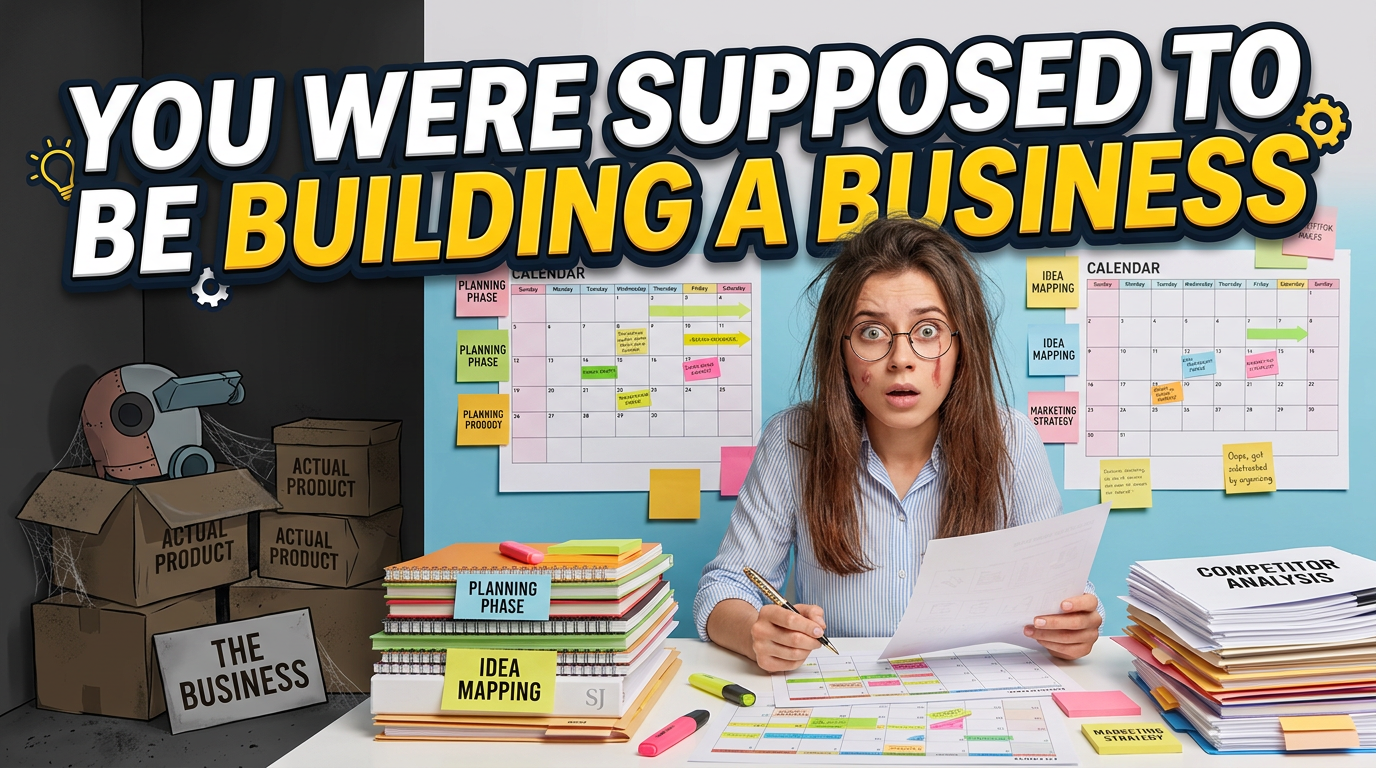
There comes a moment when you have to admit something.
You have done an impressive amount of work.
You have researched.
You have planned.
You have organized.
You have color-coded.
You have watched tutorials.
You have compared options.
You may even have a beautifully structured calendar showing exactly when you are going to start doing the thing.
There is only one small problem.
You haven't actually built the business yet.
Oops.
Welcome to Productive Procrastination
Productive procrastination is sneaky because it doesn't look like procrastination.
You're not sitting on the couch watching television.
You're working.
You're learning.
You're making lists.
You're researching your market.
You're studying your competitors.
You're figuring out which website platform to use.
You're deciding what your logo should look like.
You're creating a content calendar for the content you're eventually going to create.
You are, in fact, extremely busy.
And yet...
The business is still sitting in the corner.
Probably underneath a stack of notebooks.
Planning Is Useful. Until It Isn't.
There is nothing wrong with planning.
You need to know what you're building.
You need to understand the problem you're solving.
You need to figure out who you're helping and what you're offering.
Some research can save you from making very expensive mistakes.
The problem starts when preparation becomes a permanent phase of the business.
At some point, you don't need another spreadsheet.
You need to make the thing.
You don't need another hour of research.
You need to test the idea.
You don't need to watch another five videos about building a sales page.
You need to build a sales page.
And yes, your beautifully organized planning system may be judging you right now.
The Business Doesn't Need to Be Finished
Here's another trap.
Sometimes we think we have to understand everything before we can begin.
So we keep learning.
We tell ourselves:
“I'll start once I know how to do this properly.”
But there is a problem with that plan.
You learn a lot more after you start doing the work.
Your first product teaches you things your research couldn't.
Your first customer question teaches you something your business plan didn't.
Your first attempt at marketing gives you information you couldn't get from another tutorial.
Your first version doesn't have to be perfect.
It just has to exist.
Ask Yourself One Slightly Uncomfortable Question
What am I doing right now that feels productive but isn't actually moving the business forward?
That's a useful question.
Maybe you're researching tools instead of choosing one.
Maybe you're redesigning your website for the fourth time.
Maybe you're creating another business plan when you already have enough information to begin.
Maybe you're learning about five different ways to market your product when you haven't finished the product yet.
Maybe you're organizing your future content calendar while today's first piece of content remains unwritten.
None of those activities are automatically bad.
They're just not necessarily the next thing you need to do.
Build the Smallest Useful Version
You don't need to build the entire kingdom today.
Build the first village.
Create the first version of the product.
Put up the basic sales page.
Set up the simplest way to get paid.
Write the first email.
Publish the first piece of content.
Then see what happens.
You can improve things once you have something real to improve.
That's much easier than trying to predict every possible problem before you've even opened the castle gates.
Give Research a Finish Line
One simple way to escape the research loop is to give research a job.
Instead of:
“I'm going to research this until I understand everything.”
Try:
“I'm going to research this until I have enough information to make the next decision.”
That's a very different goal.
You don't need to know everything.
You need to know enough to take the next step.
And when you discover something else you need to learn?
Put it on the list.
Then keep building.
Your Business Needs Some Actual Business
Eventually, the notebooks have to close.
The calendars have to stop multiplying.
The color-coded sticky notes have to take a day off.
And somebody has to build the thing.
That doesn't mean you stop learning.
It doesn't mean you stop planning.
It doesn't mean you throw research out the window.
It means those things become supporting activities instead of the main event.
Because you weren't supposed to become exceptionally good at preparing to build a business.
You were supposed to be building one.
And if you happen to discover that your “simple business plan” has somehow become a 47-page strategic document with twelve tabs, three spreadsheets, and a color-coded calendar...
Well.
At least make sure there's an actual business hiding somewhere underneath it.
Comments