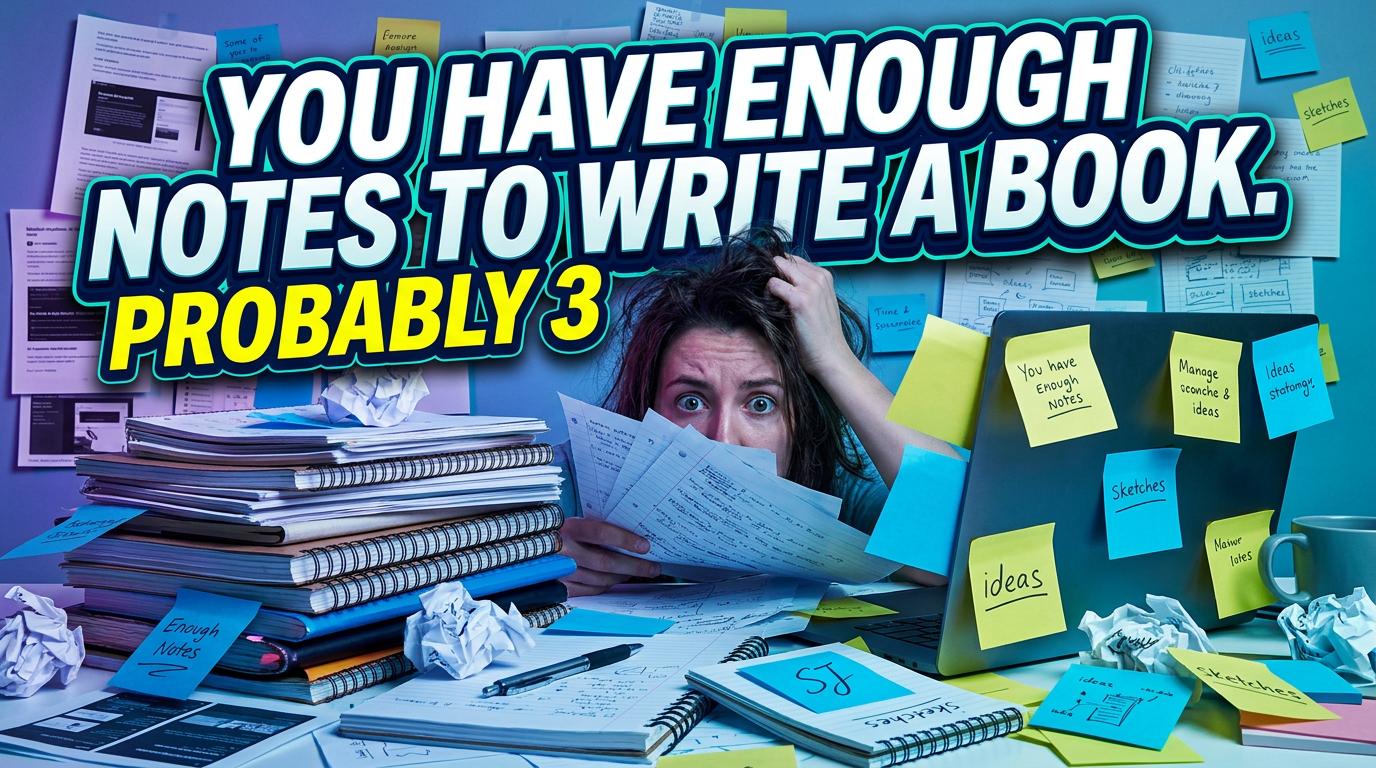
You have notes.
Lots of notes.
You have notebooks.
Documents.
Screenshots.
Saved articles.
Random pieces of paper.
Ideas written on napkins.
Things you typed into your phone at 2:17 in the morning because you were absolutely certain you would remember them later.
You did not.
But fortunately, you have the note.
Somewhere.
Probably.
At this point, you may have enough material to write a book.
Actually...
You probably have enough to write three.
There is just one problem.
They're not books yet.
Welcome to the Great Pile of Knowledge
Having information is not the same thing as having a product.
This is one of the easiest traps to fall into when you're creating digital products.
You know a lot about something.
You've learned things.
You've figured things out.
You've collected examples.
You've developed opinions.
You've probably explained the same topic to other people more than once.
So you think:
“I should turn this into a book!”
Excellent idea.
Then you open your folders.
And discover this:
Everything. Everywhere. All at once.
Your brilliant book is currently scattered across seventeen documents, four notebooks, a folder called “Ideas,” another folder called “More Ideas,” and a mysterious file called `final-final-REAL-final.docx`.
Now you have a different problem.
Notes Are Raw Material
Your notes are valuable.
But they're raw material.
Think of them like ingredients sitting on a kitchen counter.
Having flour, eggs, sugar, butter, and chocolate does not mean you have a cake.
You still have to decide what you're making.
Then you have to put the ingredients in the right order.
Then you have to actually make the thing.
Your knowledge works the same way.
You can have hundreds of pages of notes and still not have a usable product.
That's okay.
It doesn't mean the notes were wasted.
It means they're waiting to be organized.
Start Looking for the Patterns
The first step isn't writing.
It's sorting.
Look through your notes and start asking:
What keeps coming up?
What questions do you answer repeatedly?
What problems have you figured out?
What mistakes have you learned from?
What process do you follow?
What topics naturally belong together?
What would someone else find useful?
You may discover that what looked like a giant pile of unrelated information actually contains several clear themes.
That's where the book starts to appear.
Not in the blank document.
In the patterns hiding inside the notes.
Your Book Doesn't Need Every Note
This is another place where creators can get themselves into trouble.
You find something useful in your notes and think:
“Well, I can't leave that out.”
Then another.
“And this is interesting.”
Then another.
“Someone might want to know this.”
Congratulations.
Your 40-page book is now 187 pages.
And approximately 93 of those pages are there because you couldn't bear to leave anything out.
A useful product isn't a storage container for everything you know.
It's a curated experience.
You are deciding what belongs.
And just as importantly, what doesn't.
Organize for the Reader
Your notes are organized according to how you discovered the information.
Your book should be organized according to how someone else needs to understand it.
Those aren't necessarily the same thing.
Maybe you learned something in this order:
Research.
Mistake.
Random discovery.
Three months of experimentation.
Another mistake.
A helpful tutorial.
Finally figuring it out.
Your reader probably doesn't need to experience that entire archaeological expedition.
They need a clear path.
Start here.
Then do this.
Here's why it matters.
Here's an example.
Here's what to watch out for.
Now try it yourself.
That's what turns knowledge into something people can actually use.
One Pile Can Become Several Products
Here's where things get interesting.
You may discover that your notes don't contain one product.
They contain several.
A book.
A workbook.
A checklist.
A mini-course.
A collection of templates.
A resource guide.
A series of articles.
A lead magnet.
You don't have to make all of them.
In fact, please don't suddenly decide you need to make all of them.
That's how we end up writing the sequel to You Have 47 Ideas Walk Into a Business.
Instead, recognize the possibilities.
Then choose one.
The rest can go on the Later List.
Don't Confuse More With Better
You don't get bonus points for turning every scrap of knowledge you've ever collected into a product.
The goal isn't:
“How much can I put into this?”
The better question is:
“What does the reader actually need?”
A smaller, well-organized product can be much more useful than a giant information dump.
People don't necessarily need more information.
They often need someone to help them make sense of the information they already have.
That's one of the things you can create.
Your Notes May Be More Valuable Than You Think
So take another look at that pile.
The notebooks.
The documents.
The saved ideas.
The messy outlines.
The half-finished drafts.
The things you thought were too small to matter.
There may be something in there.
Maybe one book.
Maybe three.
Maybe a whole collection of smaller products.
But don't make the mistake of thinking the pile itself is the product.
The pile is the raw material.
Your job is to find the useful pieces, organize them, shape them, and turn them into something another person can actually use.
And if you discover that you have enough notes to write three books?
Wonderful.
Pick one.
Because somewhere underneath that mountain of information is probably a very good book wondering when you're finally going to organize its closet.
Comments