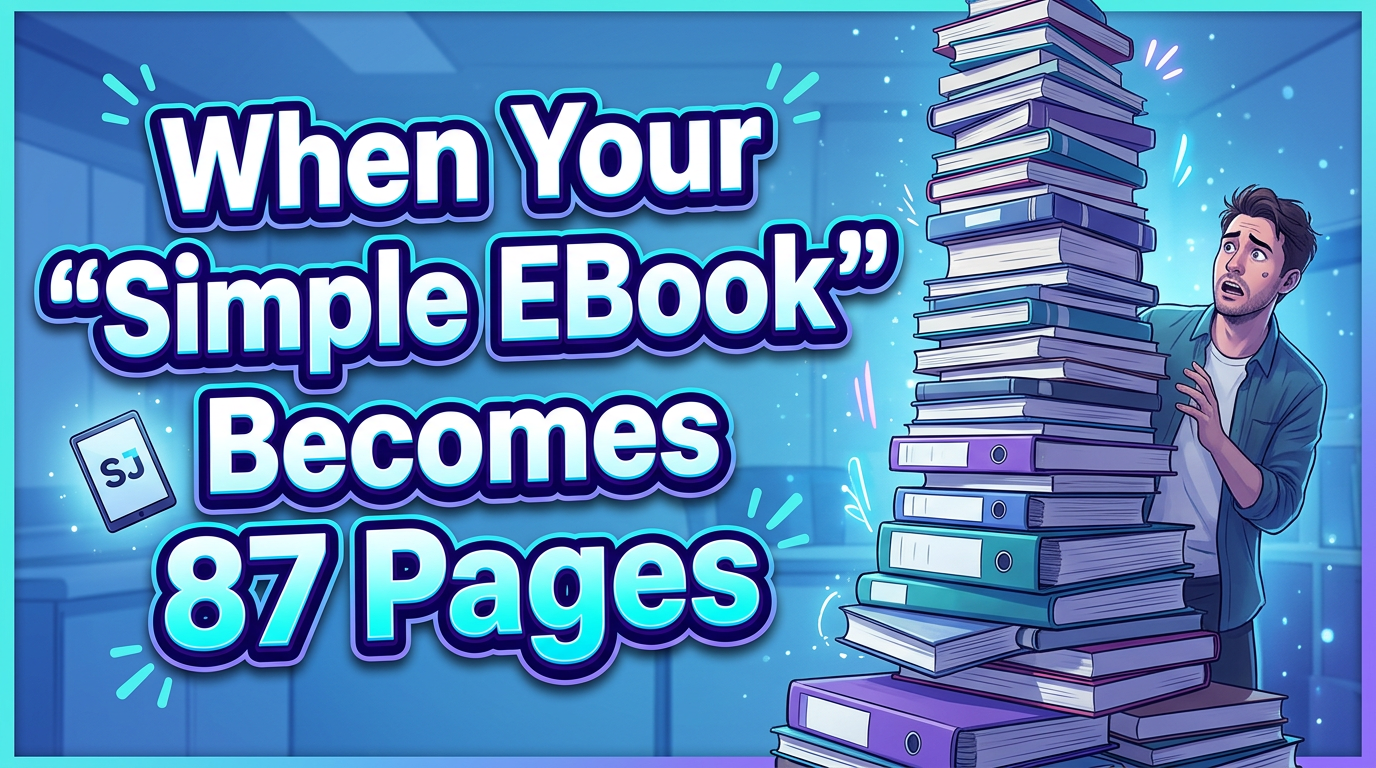
You had a simple idea.
A short ebook.
Nothing fancy. Just a helpful little guide that teaches someone how to do one specific thing.
You figured you'd write a few pages, tidy them up, add a cover, and call it done.
Easy.
Then you remembered something important.
You should probably explain that other thing, too.
And include an example.
And a checklist.
And maybe a worksheet.
Oh, and readers might have questions about the next step, so you should probably cover that.
Before you know it, your simple ebook has 87 pages, three bonus sections, and enough supplementary material to qualify as a minor university course.
You're no longer writing a guide.
You're building a literary monument.
And your original reader just wanted to know how to do one thing.
It All Started With One Helpful Addition
The expansion usually happens for good reasons.
You want your product to be useful.
You want readers to understand the material.
You don't want them getting stuck because you forgot to explain something important.
So you add a little more.
Then a little more.
Then another chapter because the subject is interesting and you happen to know quite a bit about it.
Every addition makes sense on its own.
The problem is that all those reasonable additions eventually create an unreasonable project.
Your simple guide becomes a comprehensive guide.
The comprehensive guide becomes the ultimate guide.
And the ultimate guide begins developing chapters you didn't even know existed when you started.
Somewhere along the way, you forget what you originally promised to create.
More Pages Don't Automatically Mean More Value
This is an easy trap for knowledgeable creators.
You know so much about your subject that leaving things out feels uncomfortable.
What if the reader needs that extra explanation?
What if they want to know about the advanced method?
What if they wonder about the exception to the rule?
What if they need the history, the background, the alternative approaches, and a complete comparison of every possible option?
They might.
But that doesn't mean every one of those things belongs in this particular product.
A useful product isn't a container for everything you know. It's a solution to a specific problem.
If someone buys a short guide to help them complete a task, they don't necessarily want a complete history of the task, an advanced certification curriculum, and a 42-page appendix.
They want help completing the task.
Give them what they need to do that well.
Save the rest for another product, a follow-up resource, or the Later List.
Remember Who You're Creating This For
When you're writing, it's easy to think about what you want to include.
Try thinking about what your reader needs instead.
Ask yourself:
- What problem brought this person here?
- What do they need to understand?
- What do they need to do?
- What would make the process easier?
- What information would distract them from the main goal?
That last question matters.
Sometimes an extra section makes a product more useful.
Sometimes it simply makes the product longer.
And sometimes it introduces a whole new subject that deserves its own guide.
You don't have to squeeze every related topic into the same ebook just because you know how to explain it.
Your reader needs a clear path, not a guided tour of every room in your knowledge palace.
Decide What “Finished” Means Before You Start
Here's a simple way to prevent scope creep.
Before you begin creating the product, define what it needs to accomplish.
For example:
This ebook will help beginners choose a digital product idea and outline their first version.
That's a useful boundary.
You can include the information, examples, and exercises needed to help readers achieve that goal.
But if you suddenly find yourself writing a chapter about email marketing, sales funnels, audience segmentation, and advanced automation, pause.
Are those subjects necessary for choosing and outlining the first product?
Probably not.
They may be valuable later.
They just don't belong in this project.
A clear finish line makes it easier to recognize when the product is ready.
Without one, you can keep adding material indefinitely.
And apparently, the internet is willing to let you do exactly that.
Try the “Does This Belong Here?” Test
Before adding another chapter, worksheet, bonus, or explanation, ask yourself three questions.
1. Does the reader need this to achieve the promised result?
If yes, it may belong.
2. Would leaving this out make the product confusing or incomplete?
If yes, consider including it.
3. Is this a genuinely separate topic?
If it is, you may have discovered the beginning of another product.
That doesn't mean you must create it immediately.
Write it down and return to the ebook you're supposed to be finishing.
Your future product ideas will survive the wait.
They've probably already started multiplying in your notes anyway.
Build the First Useful Version
You don't have to anticipate every possible question before releasing a product.
Create something that delivers on its promise.
Make sure the instructions are clear.
Check that the examples make sense.
Remove unnecessary repetition.
Fix the mistakes.
Then let it be finished.
You can improve the product later if you discover something genuinely needs attention.
You can create a companion workbook if readers would benefit from one.
You can develop an advanced edition when there's a good reason.
You can even turn the material into a larger course someday.
But you don't need to build every possible version before the first one exists.
Finish the product you intended to create before expanding it into the product you might create someday.
Your Ebook Is Allowed to Be Short
Let's retire the idea that a product's value can be measured by its page count.
A clear, focused 20-page guide can be more useful than a rambling 200-page ebook.
A simple checklist can solve a problem faster than an elaborate workbook.
A small collection of well-designed templates can save someone hours of work without requiring a single chapter of explanation.
The right size depends on the job.
Not your desire to include one more brilliant insight.
And certainly not the imaginary committee that keeps whispering, “But what if we added another section?”
That committee does not get to approve your table of contents.
Put the Encyclopedia Down
If your simple ebook has become 87 pages, take a breath.
You haven't necessarily done anything wrong.
You may have uncovered more useful material than you expected.
That's good news.
Now decide what belongs in this product, what belongs somewhere else, and what doesn't need to be included at all.
Your goal isn't to publish the largest possible collection of information.
It's to create something that helps another person get a useful result.
So go back to the original idea.
Look at the promise you made to your reader.
Make sure the product delivers on it.
Then stop adding chapters just because you can.
Because if your “simple ebook” needs a table of contents, an index, a glossary, a forklift, and a second volume to explain the first one...
You might not need another chapter.
You might need an editor.
Or a very firm conversation with your own enthusiasm.
Comments