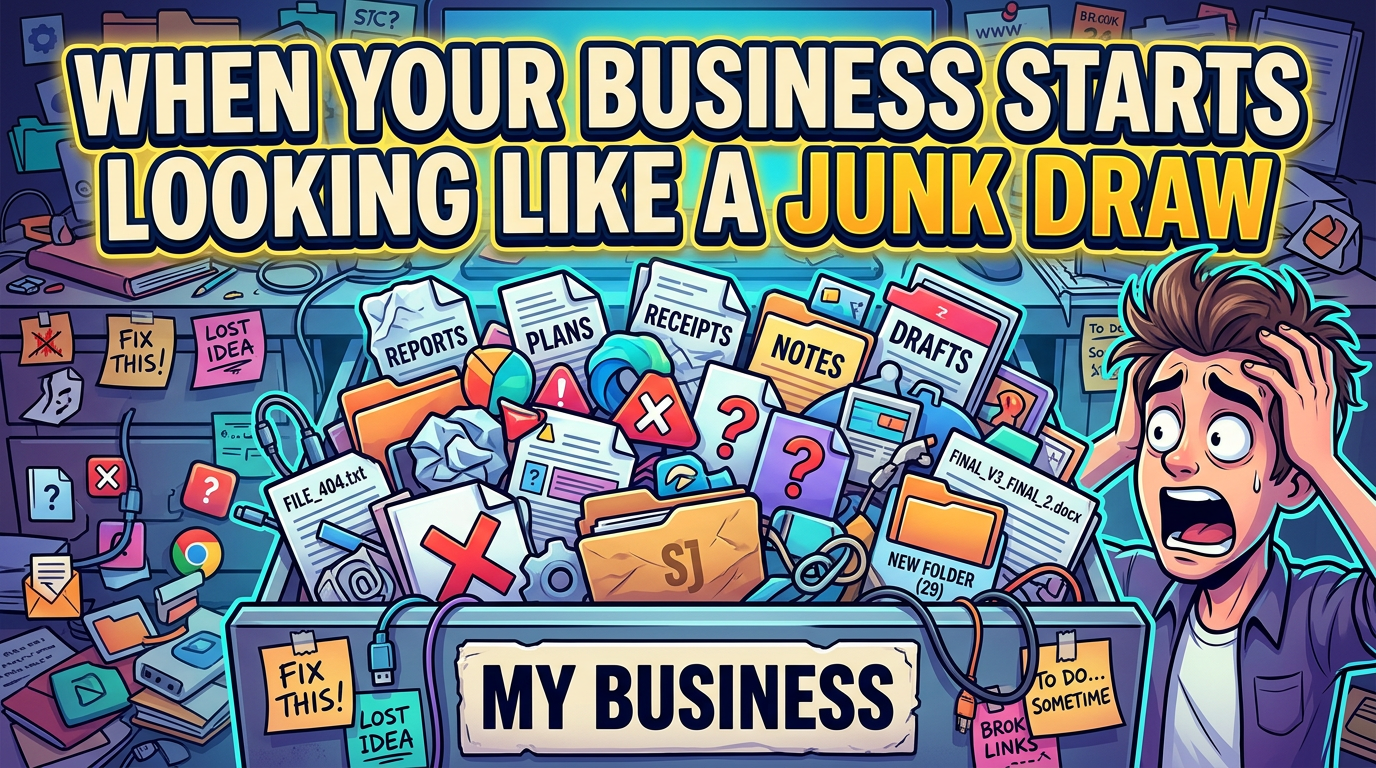
You started with a simple business idea.
You created a website.
Then you added a page for another offer.
You started a second project because it seemed like a good opportunity.
You saved a few ideas for later.
You created some graphics, downloaded some templates, started a new document, and opened a folder to keep everything organized.
That was six months ago.
Today, your business has 14 folders, 23 unfinished projects, several offers you forgot you created, and a document named FINAL_V3_FINAL_2.docx.
You also have a folder called New Folder (29).
Don't worry.
We're not here to judge.
We're here to help you find the business underneath all that stuff.
Businesses Collect Clutter, Too
Most people understand that houses accumulate clutter.
You bring something home because it's useful.
You keep something because you might need it.
You save something because it was expensive.
And eventually, you open a drawer and discover three mystery keys, a collection of rubber bands, and a charger for a device you haven't owned since 2014.
Businesses do the same thing.
You add a new offer because it might attract a different customer.
You create another page because you want to test a new approach.
You save an idea because it could become something valuable later.
You start a project because it looks promising.
None of these decisions is necessarily bad.
The problem is that every addition creates another thing to manage.
Over time, the business becomes harder to understand, harder to maintain, and harder to work on.
You aren't necessarily short on opportunities.
You may simply have too many things competing for your attention.
The Business Junk Drawer Has Several Compartments
Business clutter doesn't always look like a messy desktop.
Sometimes it's hiding in plain sight.
The Offer Collection
You have several products, services, bundles, and special offers.
Some are active.
Some haven't sold in months.
Some were created for an audience you no longer serve.
And one is still listed because you haven't decided what to do with it.
The Project Pile
You have unfinished ebooks, half-built websites, abandoned courses, draft newsletters, and ideas that were supposed to become something important.
They're all waiting for you.
Apparently, they have formed a committee.
The Page Problem
Your website has multiple landing pages, old promotions, outdated links, and pages you created for experiments that ended a long time ago.
You can't remember whether some of them are still connected to anything.
The File Collection
There are duplicate graphics, old versions of documents, saved templates, random downloads, and folders inside folders.
Somewhere in there is the file you actually need.
You just have to locate it before your coffee gets cold.
The Tool Accumulation
You've signed up for platforms, apps, subscriptions, and services.
Some are essential.
Some are occasionally useful.
Others haven't been opened since the day you created the account.
You might even be paying for a few of them.
That one deserves a closer look.
Not Everything Is Clutter
Before you start deleting things, let's make one distinction.
Having several projects, offers, or tools doesn't automatically mean your business is disorganized.
A business can have multiple revenue streams and still operate smoothly.
A collection of resources can be valuable.
An unfinished idea might be worth revisiting.
A tool you only use occasionally might still be important.
The goal isn't to own as little as possible.
It's to make sure the things you keep have a reason to be there.
Useful variety is different from unmanaged accumulation.
The question isn't whether you have too much.
It's whether what you have is helping you build the business you actually want.
Give Your Business a Little Decluttering Session
You don't need to reorganize your entire business in one afternoon.
Start with one area.
Choose the one that's causing the most frustration.
Maybe it's your offers.
Maybe it's your website.
Maybe it's the mountain of unfinished projects.
Then sort what you find into four simple groups.
1. Keep
These things are useful, active, and serving a purpose.
Keep them.
2. Finish
These are worthwhile projects that are close enough to completion to deserve your attention.
Choose one or two to work on rather than trying to finish everything simultaneously.
3. Save for Later
These are ideas, resources, and projects that may be useful someday but don't need your attention right now.
Put them somewhere you can find them again.
4. Retire
These are things that no longer serve your business.
Old promotions, duplicate files, outdated offers, unused subscriptions, and projects you've decided not to pursue.
Remove them when you're sure they're no longer needed.
For anything connected to your website, email list, or sales process, check its connections before removing it.
You don't want to accidentally delete something important and create a brand-new problem.
Create a Home for the Things You Keep
Once you've sorted things out, give the important pieces a clear place.
You don't need a complicated organizational system.
You just need to know where things belong.
For example:
- Current Projects: What you're actively building.
- Products & Offers: What you're selling or preparing to sell.
- Marketing Materials: Graphics, emails, and promotional content.
- Business Resources: Templates, research, and useful reference materials.
- Later List: Ideas and projects you're not working on right now.
- Archive: Completed or retired materials you may need to reference.
Your system can be digital folders, a project tracker, a spreadsheet, or another method that makes sense for your workflow.
The best system is one you'll actually maintain.
And please, give your folders names that make sense.
New Folder (29) is not a filing strategy.
It's a cry for help.
Make Decluttering Part of Your Routine
You don't have to wait until your business becomes a disaster zone to clean things up.
A little maintenance can prevent a lot of frustration.
Once a month, take a look at what's accumulating.
Are there unfinished projects that need a decision?
Are there offers that need updating?
Are there tools you're no longer using?
Are there old pages or promotions that need attention?
Are you adding new things faster than you're finishing or maintaining the ones you already have?
You don't need to turn this into another enormous business task.
Even a short review can help you keep things manageable.
Your Business Doesn't Need to Be a Junk Drawer
Building a business means creating things.
You'll experiment.
You'll try new approaches.
You'll discover opportunities you hadn't considered.
Some projects will work.
Some won't.
Some will need to be changed.
That's normal.
But you don't have to keep every idea, offer, page, and project forever.
You can retire things.
You can simplify.
You can decide that something no longer deserves your time.
And you can make room for the work that actually matters.
So take a look inside that giant business junk drawer.
Find the useful things.
Finish what deserves finishing.
Put the future ideas somewhere safe.
And let go of the things that are simply taking up space.
Because your business should be a collection of things working together—not a storage unit for every idea you've ever had.
Now, if you'll excuse me, there's a folder named Miscellaneous Miscellaneous that needs investigating.
I'm a little afraid of what we'll find in there.
Comments