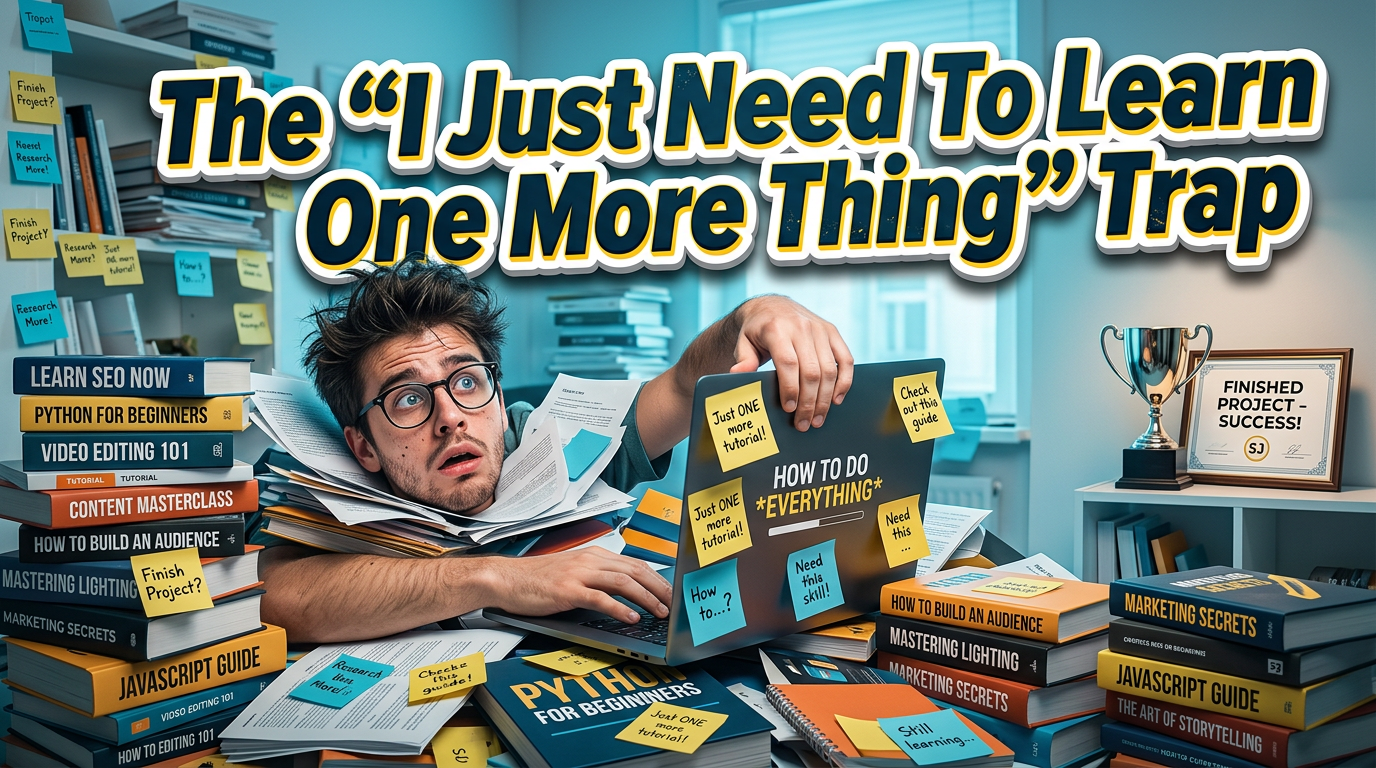
You were going to finish your project today.
You really were.
But then you realized you needed to learn a little more about marketing.
So you watched a tutorial.
Which mentioned a useful SEO technique.
Naturally, you watched another tutorial about that.
Then you discovered a new tool, a better workflow, and a course that promised to teach you everything you needed to know about building a successful business.
You bought the course.
You bookmarked twelve videos.
You downloaded three guides.
And somewhere in the middle of all that learning, your original project quietly disappeared beneath a mountain of educational materials.
But look on the bright side!
You're becoming extremely knowledgeable about how to build a business.
You just haven't built much of one yet.
Learning Feels Like Progress
Here's why this trap is so easy to fall into.
Learning is useful.
You discover new ideas. You improve your skills. You understand how things work. You find better ways to solve problems.
And unlike putting your work in front of actual customers, learning can feel wonderfully safe.
Nobody rejects your unfinished product while you're watching a tutorial.
Nobody questions your sales page while you're taking notes.
Nobody ignores your marketing campaign while you're studying how marketing campaigns work.
You can spend an entire afternoon learning and finish the day feeling productive.
Sometimes you really have made progress.
Other times, you've simply become better prepared to do the thing you were already prepared enough to begin.
Learning feels productive because it often is productive. That's what makes it such an excellent hiding place for procrastination.
The Goalposts Keep Moving
At first, you think you need to learn how to create your product.
You learn that.
Then you decide you need to understand branding before you can publish it.
So you study branding.
Then you need better graphics.
Then you need to learn copywriting.
Then email marketing.
Then audience growth.
Then automation.
Then video editing.
Then perhaps a little Python, just in case your digital product business unexpectedly requires you to become a software developer.
Each new skill creates another possible reason to delay.
The problem isn't that these skills are useless.
Many of them could help you eventually.
The problem is that you've started treating every useful skill as a requirement for getting started.
And there will always be another useful skill.
Always.
The internet is practically an infinite buffet of things you could learn.
You do not have to eat everything before you leave the restaurant.
You Don't Need to Know Everything
Think about the next step in your business.
Maybe you need to finish a short ebook.
Do you need to master every aspect of digital publishing before you can finish it?
No.
You need to know enough to complete the ebook you're creating.
Perhaps you need to publish a simple sales page.
You don't necessarily need an advanced course in conversion optimization before you write your first version.
Maybe you need to make your first video.
You can learn the basic recording and editing skills required to make that video without becoming an expert in every video-production technique.
The goal isn't to avoid learning.
It's to learn what you need when you need it.
You can develop additional skills as your business grows and new challenges appear.
You don't have to prepare for every possible future problem before solving the one directly in front of you.
Try the “What Will I Do With This?” Test
Before you start another tutorial, ask yourself one question:
What will I do with what I'm about to learn?
If the answer is clear, excellent.
You need to learn how to format your ebook so you can finish it.
You need to understand how to connect your payment method so you can accept orders.
You need to learn how to write a clearer headline because your current one isn't communicating the offer.
Those are practical reasons to learn.
But if the answer is something like “It might be useful someday” or “I should probably know this before I start,” pause.
Could the lesson wait?
Could you complete your current task without it?
Are you learning because you have a real problem to solve, or because doing the actual work feels uncomfortable?
You don't have to answer those questions perfectly.
Just asking them can help you recognize when your learning habit needs a little supervision.
Put Your Learning on a Leash
You don't have to stop taking courses or watching tutorials.
You might simply need a better way to manage them.
Try these three small changes.
1. Choose the task before choosing the tutorial.
Decide what you're trying to accomplish first. Then find the information that will help you do it.
This keeps you from wandering through unrelated lessons because the titles look interesting.
2. Apply what you learn before moving on.
If a tutorial teaches you a useful technique, try using it.
You don't have to master every detail before applying the basics.
A skill becomes much more valuable when you put it to work.
3. Keep a learning Later List.
When you discover an interesting topic that isn't necessary right now, write it down.
You can return to it when the need arises.
That way, you don't have to forget the idea or follow every interesting detour immediately.
Your Later List isn't a rejection of learning.
It's a way to keep learning from hijacking the work you've already chosen to do.
Measure What You Finish, Too
There's nothing wrong with being a lifelong learner.
Curiosity is valuable. Skills matter. Knowledge can open doors you didn't even know existed.
But if you're building a business, learning shouldn't be the only thing you measure.
Look at what you've actually done with your knowledge.
Did you finish the product?
Did you publish the page?
Did you test the idea?
Did you share your work with potential customers?
Did you take a step that moved your business forward?
You don't have to accomplish something enormous every day.
Small, finished actions count.
And sometimes the most useful thing you can do with another piece of information is apply it to the project you've already started.
Go Collect Your Trophy
Look at that creator in the picture.
Books everywhere.
Tutorials waiting to be watched.
Skills still to be learned.
And a trophy sitting on the shelf for a finished project.
The trophy isn't there because the creator learned everything.
It's there because something got finished.
That's the part worth remembering.
You don't need to know every marketing strategy before you publish your first useful post.
You don't need to master every design tool before you create your first product.
You don't need to understand every possible business model before you test one.
Learn what helps you take the next step.
Apply it.
Keep moving.
Then learn what you need for the step after that.
Because your business doesn't grow just because your knowledge grows. It grows when you put that knowledge to work.
So go ahead and watch the tutorial you actually need.
Take a few notes.
Try the technique.
Then close the browser and get back to your project.
That finished-project trophy has been sitting there long enough.
It would really like some company.
Comments