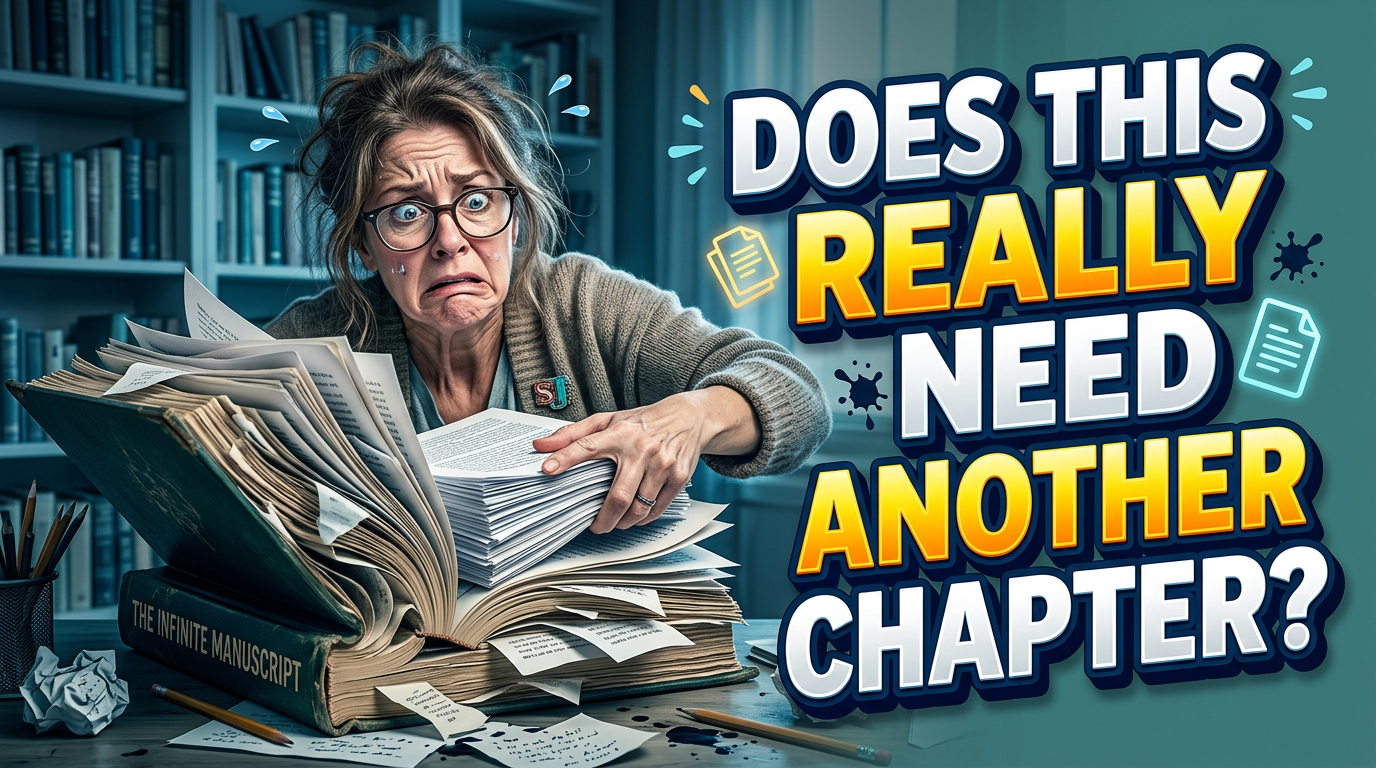
You finish a chapter.
You feel good about it.
Then you have another thought.
Oh! I should probably explain this other thing, too.
So you add a section.
While writing that section, you realize readers might need an example.
You add an example.
Then you think of an exception to the rule, a useful tip, and a related topic that deserves a little explanation.
Naturally, you add those, too.
A few hours later, your ebook has grown by twelve pages, and you're staring at the screen wondering whether you should include a glossary.
You started with a simple guide.
Now you're responsible for the Infinite Manuscript.
And it keeps demanding more chapters.
The More-Is-Better Myth
When you're creating a digital product, it's tempting to believe that more content means more value.
More chapters.
More examples.
More worksheets.
More bonus materials.
More information to justify the price.
After all, you want customers to feel they've received something worthwhile.
But here's the problem.
More information doesn't automatically make a product more useful.
Sometimes, additional material helps readers understand a concept or complete a task.
Sometimes, it gives them helpful context.
And sometimes, it makes a straightforward process feel unnecessarily complicated.
Imagine buying a guide that promises to help you choose your first digital product.
You expect clear steps to help you make that decision.
Instead, you get 40 pages about branding, a history of online marketing, an introduction to email automation, and a bonus chapter about building a membership site.
All potentially useful subjects.
But now you're wondering whether you need to complete a small business degree before choosing an ebook topic.
That's not necessarily added value.
It may simply be added work.
Every Chapter Needs a Job
A chapter shouldn't exist just because you know something interesting.
It should help the reader accomplish the purpose of the product.
Before adding another section, ask yourself:
- Does this help the reader reach the promised result?
- Does the reader need this information right now?
- Would leaving it out create a genuine gap or confusion?
- Does this belong in this product, or is it a separate topic?
If the chapter helps readers understand what to do or makes the process easier, it may deserve a place.
If it introduces a subject that readers can explore later, consider saving it for another resource.
And if you're adding it simply because the ebook feels too short, put the keyboard down.
Page count is not a measure of usefulness.
Neither is the number of times you can say, “There's one more thing you should know.”
Don't Make Readers Work Harder Than Necessary
Your knowledge is valuable.
But your reader doesn't necessarily want to know everything you know.
They want to solve a problem, learn a skill, complete a task, or reach a particular goal.
Your job is to help them get there.
That means deciding what information is essential, what information is helpful, and what information can wait.
Sometimes the best thing you can do for a reader is leave something out.
Not because it's unimportant.
Because it isn't necessary for the job this particular product is supposed to do.
A focused guide can be easier to follow than a comprehensive resource that tries to cover everything.
A short checklist can help someone take action faster than 30 pages of explanation.
A simple template can save time without requiring an entire chapter about how to use it.
The goal isn't to give readers the most information possible. It's to give them the right information for the result they're trying to achieve.
Give Your Product a Boundary
One of the easiest ways to prevent endless expansion is to define the product's purpose before you start creating it.
Write one sentence describing what the reader should be able to do after using it.
For example:
This guide will help beginners choose a digital product idea and outline a simple first version.
That sentence gives you a boundary.
You can include the information needed to choose the idea and outline the product.
You can add examples, exercises, and practical guidance that support that goal.
But if you suddenly find yourself writing a chapter about advanced email marketing, ask whether it belongs.
It might be useful for someone who already has a product and needs to promote it.
It probably isn't essential for someone who hasn't chosen what to create.
That topic may deserve its own resource.
And look at that—you've discovered another product idea without turning the current one into an encyclopedia.
Write the idea down.
Return to the project you're building.
Use the “Later” Shelf
Sometimes a new section really is a good idea.
You don't have to discard it just because it doesn't belong in the current product.
Create a Later List for material that might be useful in the future.
You can save ideas for:
- A companion workbook.
- An advanced guide.
- A separate ebook.
- A follow-up email series.
- A bonus resource.
- A future course.
You don't have to build any of those things today.
The Later List lets you preserve good ideas without giving each one permission to interrupt your current project.
It also helps you recognize when you've discovered a separate product instead of another chapter.
Your knowledge can become a collection of useful resources over time.
It doesn't all have to live inside one enormous ebook.
Know When to Stop
At some point, you need to decide that your product is finished.
Not perfect.
Not complete in every possible way.
Finished enough to deliver the result you promised.
The instructions are clear.
The examples make sense.
The essential information is there.
You've checked for mistakes and removed unnecessary repetition.
The product does its job.
That is a reasonable finish line.
You can improve it later if you discover a genuine problem or identify something that would make it more useful.
But you don't need to anticipate every possible question or include every related subject before letting the product out into the world.
A finished, focused product is more useful than an endlessly expanding product that never gets released.
Close the Infinite Manuscript
If you find yourself asking whether your ebook needs another chapter, pause before adding one.
Maybe it does.
Maybe the reader needs that missing explanation.
Maybe the new section would make the product clearer or help someone achieve the promised result.
But maybe you're adding more because you can.
Maybe you're uncomfortable calling the project finished.
Maybe you're confusing a larger product with a better one.
Take another look at the purpose of the product.
Check whether the new material supports it.
Then make a deliberate decision.
You don't have to include everything you know.
You don't have to answer every question a reader might someday ask.
And you certainly don't have to turn every useful thought into another chapter.
Because somewhere in that Infinite Manuscript, your original product is still waiting to be finished.
Give it a chance.
Let every chapter earn its place.
And remember:
The best product isn't necessarily the biggest one. It's the one that helps the reader get where they wanted to go.
Now close the manuscript.
Before it asks you to write a sequel.
Comments