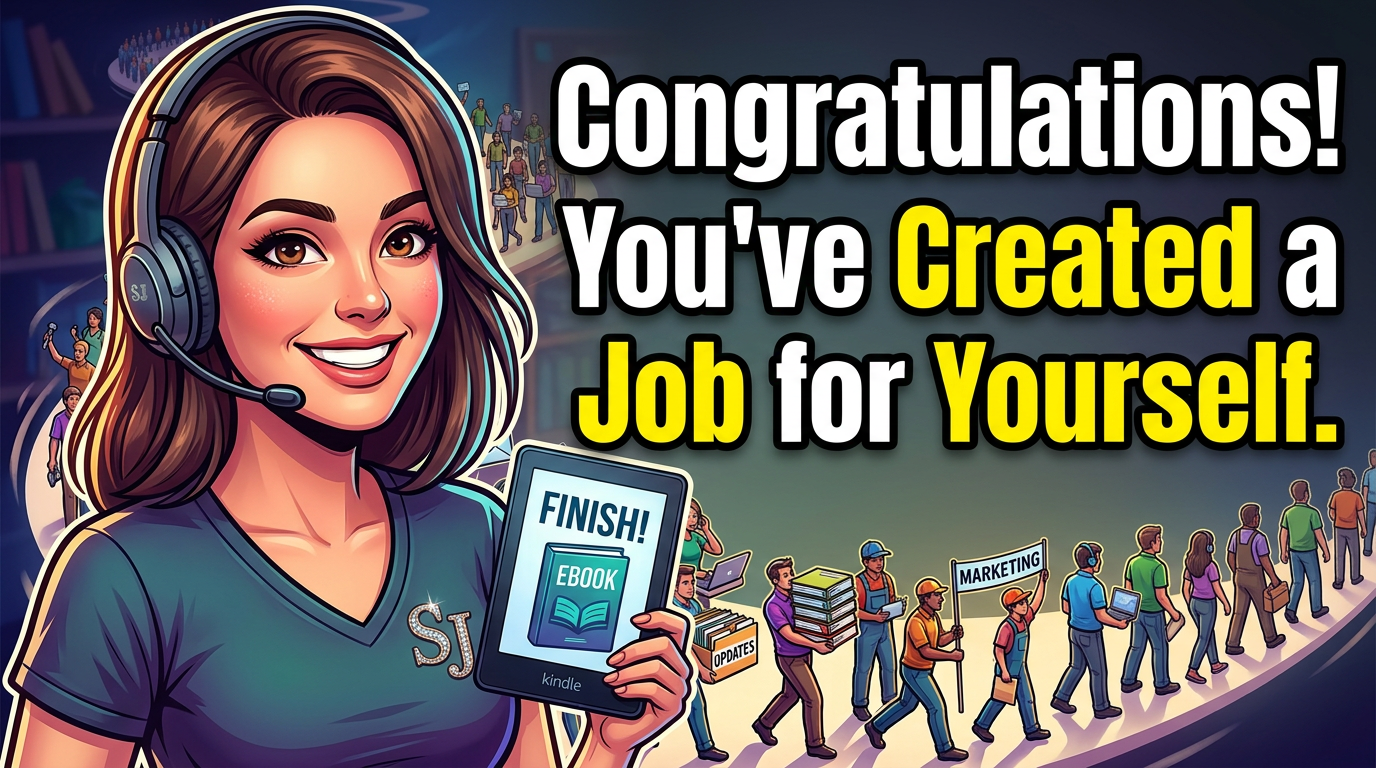
You wanted a business. Somehow, you became the employee.
There is a moment in many creator businesses when you stop and think:
“Wait a minute. When am I supposed to actually have a life?”
You started with a simple idea.
Maybe you were going to create an ebook.
Or a printable.
Or a membership.
Or a little collection of digital products.
Something manageable.
Something that could make money without requiring you to be everywhere, do everything, and answer to twelve different versions of yourself.
And then you built it.
Congratulations!
You have created a job for yourself.
It Started Out So Innocently
At first, the product seemed simple.
Create the thing.
Put it somewhere people can buy it.
Tell people about it.
Done.
Except then you realized you needed a sales page.
And an email list.
And emails.
And social posts.
And customer questions.
And updates.
And graphics.
And maybe a freebie.
And another freebie because the first freebie wasn't quite right.
Suddenly your “simple little digital product” has developed a management team.
Unfortunately, the management team is also you.
A Product Can Be Simple
There's nothing wrong with creating something that requires work.
Businesses require work.
Products require work.
Customers occasionally have questions that cannot be answered by staring intensely at your computer.
That's normal.
The problem happens when the thing you built becomes so complicated that keeping it running takes more energy than creating it did.
For example, maybe you create a product that requires:
- Constant updates
- Personalized support
- Frequent new content
- Complicated delivery
- Multiple platforms
- Regular live sessions
- A complicated sales process
None of those things are automatically bad.
But put them all together and you may have created something that requires you to show up every day just to keep the doors open.
That's not necessarily a business model.
That's a job description.
Ask Yourself: What Am I Actually Building?
This is a useful question to ask before adding another feature:
What will this require from me after I build it?
Not just:
“Can I make this?”
But:
“Can I keep doing this?”
Those are two very different questions.
You might be perfectly capable of creating a 200-page course.
That doesn't mean you want to spend the next three years maintaining it.
You might be able to offer custom services.
That doesn't mean you want every sale to create another appointment on your calendar.
You might be able to create a giant product catalog.
That doesn't mean you want to maintain 147 products.
Being able to build something isn't the same as wanting to manage it.
Build for the Version of You Who Comes Later
Here's the part that's easy to forget.
The person building the business today is usually enthusiastic.
You have an idea.
You're excited.
You're willing to spend Saturday afternoon getting everything just right.
Future You may have other plans.
Future You may have three more products to create.
Future You may want to take Tuesday afternoon off.
Future You may have absolutely no interest in updating seventeen separate sales pages because one sentence changed.
Future You deserves some consideration.
So when you're building something, don't just ask:
“How impressive can I make this?”
Ask:
“How manageable can I make this?”
Simple Isn't Lazy
Sometimes creators worry that a simpler business isn't a “real” business.
So they add things.
More features.
More bonuses.
More products.
More content.
More offers.
More complexity.
Because surely a serious business needs to look complicated.
It doesn't.
A simple product that solves a real problem can be a perfectly legitimate business.
A small product line can be a business.
A focused service can be a business.
A business that you can actually operate without becoming permanently attached to your computer is also a perfectly reasonable goal.
Simple isn't lazy.
Sometimes simple is what makes the whole thing possible.
You Don't Have to Build the Whole Kingdom
There's a temptation to build the biggest version of the idea immediately.
The complete course.
The giant membership.
The enormous product library.
The elaborate website.
The automated everything machine.
But you don't know yet what your customers will actually use.
You don't know which parts they'll love.
You don't know which parts they'll ignore.
You don't even know whether you'll still like the business model six months from now.
So why build the entire kingdom before you've visited the first village?
Build enough to begin.
Then pay attention.
Learn.
Adjust.
Simplify.
Add something when there's a reason to add it.
That's a much easier way to build something that can grow without becoming a monster.
Your Business Should Fit Your Life
This doesn't mean your business should require no effort.
It means the effort should make sense.
If you want a business that gives you flexibility, don't accidentally build one that requires you to be available every waking hour.
If you want to sell digital products, think about how much ongoing work each product creates.
If you want recurring revenue, think about what you have promised to provide in return.
If you want freedom, build with freedom in mind.
Because here's the funny thing:
You can absolutely create a successful business that you eventually hate running.
The goal isn't simply to build something people will buy.
It's to build something you can realistically keep operating.
The Real Congratulations
So, congratulations.
You created a job for yourself.
Now take a good look at it.
Is it a job you actually want?
Does it fit the life you're trying to build?
Can you manage it when the excitement wears off?
Can you maintain it without constantly adding more hours?
If the answer isn't quite what you hoped, that's not failure.
It just means you found something that needs adjusting.
And that's much easier to fix before you've built the castle, hired the imaginary staff, and discovered that you're somehow responsible for emptying all the royal chamber pots.
Build the thing.
Just make sure the thing doesn't end up building you.
Comments